CHYE-006
Forwarding Incoming Fax Documents to a Shared Folder
This section describes how to forward incoming fax documents to a shared folder registered in the Address Book.
Perform steps 1 to 2 in order.
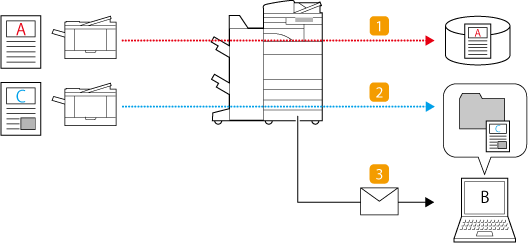
This section describes the "procedure for forwarding incoming fax documents to a shared folder" in the following scenarios:
 Forwarding faxed documents from company A (fax no. 0011111111) to the sales team's server
 Forwarding faxed documents from companies other than company A to the computer of user B in the sales office (shared folder)
 Notifying user B by e-mail when incoming faxed documents are forwarded
Movement of Incoming Fax Documents After the Forwarding Settings Are Configured
NOTE
First check that the following settings have been completed:
That faxes can be used
That the Send functions are enabled
That the network settings have been configured
Screens may differ depending on your model and the installed options.
Step 1: Registering the Forwarding Destination in the Address Book
Registering the "Sales Team Server" in the Address Book
1
On the <Home> screen, press <Dest./Fwd. Settings>.
2
Press <Register Destinations>  <Register New Destination>.
<Register New Destination>.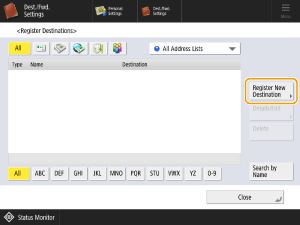
3
Press <File>.
4
Enter the "Sales Team Server" information.
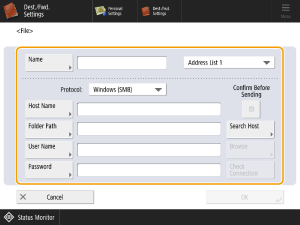
<Name>
Enter the destination name you want to view in the Address Book. Here, "Sales Team Server" is entered.
Press <Name> enter the destination name, and then press <OK>.
enter the destination name, and then press <OK>.Where to register destinations
Select a destination from <Personal Address List>, user group address list, <Address List 1> to <Address List 10> or <Address List for Administrator>.
When registering destinations for your own use, select <Personal Address List>.
When registering destinations that only an Administrator can edit, select <Address List for Administrator>.
To share a destination with a registered user group, select the registered user group address list.
NOTE
<Address List 1> to <Address List 10> can be likened to 10 address books. Registering destinations in address lists for each department or business partner makes it easier to find destinations when specifying them. It also makes it easy to manage address lists by simply renaming a department or business partner.
<Protocol>
Here, <Windows (SMB)> is selected.
NOTE
When you select <Windows (SMB)>, the <Search Host> and <Browse> buttons appear. This makes it easy to specify the file server when browsing or searching on a network.
You can only use <Browse> if <1.0> is set to <On> in <Specify SMB Client Version>.
You can register up to five Directory servers to be used with <Browse>.
<Host Name>
Enter the path for the file server.
E.g.: \\File server computer name\Sales_Department
E.g.: \\File server computer name\Sales_Department
<Folder Path>
To create a folder for sorting on the file server, enter the folder name. You can also send the file without entering a folder name.
E.g.: \FAX_from_A
E.g.: \FAX_from_A
NOTE
If you set <Protocol> to <Windows (SMB)> and then specify a non-existent folder in <Folder Path>, a folder is automatically created and the file is saved in the created folder. However, if you specified non-existent folders on multiple levels, a send error occurs.
<User Name>
Enter the user name used when logging in to the file server.
<Password>
Enter the password for the user name.
<Confirm Before Sending>
If you set <Confirm Before Sending> to ON, a screen appears requesting a password before the file is sent, even if you have already entered the password in <Password>.
NOTE
If you specify a destination with <Confirm Before Sending> enabled as the forwarding destination, the password input screen does not appear. The file is forwarded using the registered password.
5
Press <Check Connection> to check the connection.
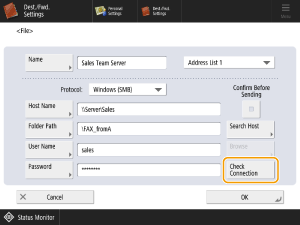
6
Press <OK> <Close>.
<Close>.Registering a "Shared Folder on User B's Computer" in the Address Book
1
On the <Home> screen, press <Dest./Fwd. Settings>.
2
Press <Register Destinations> <Register New Destination>.
<Register New Destination>.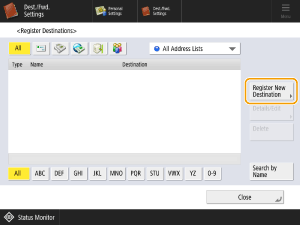
3
Press <File>.
4
Enter the information for "Shared Folder on User B's Computer."
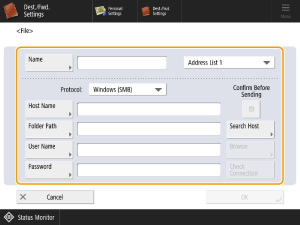
<Name>
Enter the destination name you want to view in the Address Book. Here, "B's folder" is entered.
Press <Name> enter the destination name, and then press <OK>.
enter the destination name, and then press <OK>.Where to register destinations
Select a destination from <Personal Address List>, user group address list, <Address List 1> to <Address List 10> or <Address List for Administrator>.
When registering destinations for your own use, select <Personal Address List>.
When registering destinations that only an Administrator can edit, select <Address List for Administrator>.
To share a destination with a registered user group, select the registered user group address list.
NOTE
<Address List 1> to <Address List 10> can be likened to 10 address books. Registering destinations in address lists for each department or business partner makes it easier to find destinations when specifying them. It also makes it easy to manage address lists by simply renaming a department or business partner.
<Protocol>
Here, <Windows (SMB)> is selected.
NOTE
When you select <Windows (SMB)>, the <Search Host> and <Browse> buttons appear. This makes it easy to specify the file server when browsing or searching on a network.
You can only use <Browse> if <1.0> is set to <On> in <Specify SMB Client Version>.
You can register up to five Directory servers to be used with <Browse>.
<Host Name>
Enter the path for the shared folder on user B's computer.
E.g.: \\Computer name\Scan
E.g.: \\Computer name\Scan
<Folder Path>
To create a folder for sorting inside the shared folder, enter the folder name. You can also send the file without entering a folder name.
E.g.: \FAX
E.g.: \FAX
NOTE
If you set <Protocol> to <Windows (SMB)> and then specify a non-existent folder in <Folder Path>, a folder is automatically created and the file is saved in the created folder. However, if you specified non-existent folders on multiple levels, a send error occurs.
<User Name>
Enter the user name used when logging in to user B's computer.
<Password>
Enter the password for the user name.
<Confirm Before Sending>
If you set <Confirm Before Sending> to ON, a screen appears requesting a password before the file is sent, even if you have already entered the password in <Password>.
NOTE
If you specify a destination with <Confirm Before Sending> enabled as the forwarding destination, the password input screen does not appear. The file is forwarded using the registered password.
5
Press <Check Connection> to check the connection.
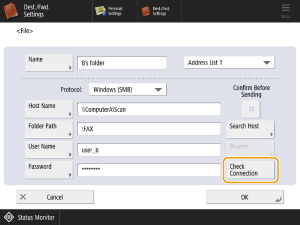
6
Press <OK> <Close>.
<Close>.Registering User B's E-Mail Address in the Address Book
1
On the <Home> screen, press <Dest./Fwd. Settings>.
2
Press <Register Destinations> <Register New Destination>.
<Register New Destination>.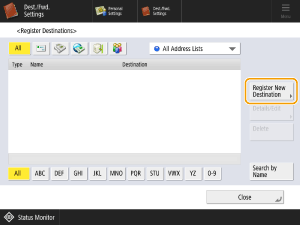
3
Press <E-Mail>.
4
Enter the information for "User B's E-Mail Address."
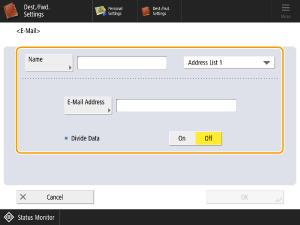
<Name>
Enter the destination name you want to view in the Address Book. Here, "B's e-mail" is entered.
Press <Name> enter the destination name, and then press <OK>.
enter the destination name, and then press <OK>.Where to register destinations
Select a destination from <Personal Address List>, user group address list, <Address List 1> to <Address List 10> or <Address List for Administrator>.
When registering destinations for your own use, select <Personal Address List>.
When registering destinations that only an Administrator can edit, select <Address List for Administrator>.
To share a destination with a registered user group, select the registered user group address list.
NOTE
<Address List 1> to <Address List 10> can be likened to 10 address books. Registering destinations in address lists for each department or business partner makes it easier to find destinations when specifying them. It also makes it easy to manage address lists by simply renaming a department or business partner.
<E-Mail Address>
Enter user B's e-mail address.
<Divide Data>
When the size of a file exceeds the limit for e-mail transmission, you can choose to divide the file based on either size or pages.
When you set this to <On>, the file is divided so that it no longer exceeds the limit and sent as multiple deliveries. The recipient's e-mail software must support a function for re-joining the received file.
When you set this to <Off>, the number of pages sent each time is reduced and the pages are sent in multiple e-mails. For example, a 10-page file is divided into two and sent as two 5-page files, so the recipient receives two e-mails. However, if the file does not contain any pages (e.g. a JPEG image), a send error occurs.
5
Press <OK> <Close>.
<Close>.NOTE
Before configuring the forwarding settings, use the <Scan and Send> function to check that the file definitely arrived at the registered destination.
Step 2: Configuring the Forwarding Settings for Incoming Fax Documents
1
Log in as an administrator on this machine's control panel. Logging In as an Administrator
2
On the <Home> screen, press  (Settings/Registration).
(Settings/Registration).3
Press <Function Settings> <Receive/Forward> <Receive/Forward> <Forwarding Settings>.
<Receive/Forward> <Receive/Forward> <Forwarding Settings>.4
Press <Register>.
5
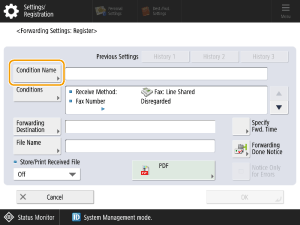
Press <Condition Name>, enter "Faxes from Company A" and then press <OK>.
6
Press <Forwarding Conditions>, set the conditions for the destination(s) for forwarding and then press <OK>.
In <Receive Method:>, select <Fax: Line Shared>.
In <Fax Number>, select <Equals> from the drop-down menu and then use the numeric keys to enter the fax number for "Faxes from Company A"(0011111111).
NOTE
The basic registration number for a destination fax may use a zero prefix, a space or a country code. Depending on the use of these characters, the forwarding conditions differ. If it is unclear whether or not they are used, select <Contains>without selecting <Equals>.
7
Press <Forwarded To> <Address Book>.
<Address Book>.8
Select the registered "Sales Team Server" as the forwarding destination and press <OK>.
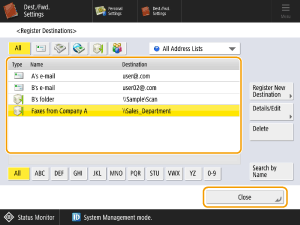
9
Press <File Name>, enter "Faxes from Company A" and then press <OK>.
NOTE
For the file name, enter the file name used for storing the file on the forwarding destination file server. You can use any name.
A file scanning date/time stamp is appended to the end of the file name. If no name is specified, the file scanning date/time stamp only is appended and cannot be deleted.
10
Press <Forwarding Done Notice>.
11
Select user B's e-mail address and press <OK> <OK>.
<OK>.This ensures that forwarding e-mail notifications are sent to "user B's e-mail address" when incoming fax documents are forwarded to the "Sales Team Server." Check the incoming fax documents as needed.
12
Select "Faxes from Company A" and press <Validate/Invalidate> to set it to <On>.
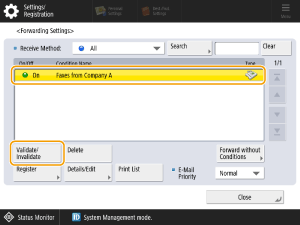
"Faxed documents from Company A" are forwarded to the "Sales Team Server."
Next, configure the forwarding settings for "Faxed documents from companies other than company A."
NOTE
If this is set to <Off>, documents are printed without being forwarded to a file server.
13
Press <Forward without Conditions>.
NOTE
To forward all other incoming fax documents that do not meet the forwarding conditions, select <Forward without Conditions>.
If you do not specify the <Forward without Conditions> setting, fax documents received from companies other than Company A are printed or held in memory without being forwarded.
14
Press <Forwarded To> <Address Book>.
<Address Book>.15
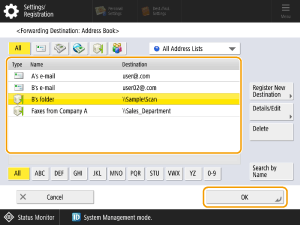
Select the registered "B's folder" as the forwarding destination and press <OK>.
16
Press <Forwarding Done Notice>.
17
Select user B's e-mail address and press <OK> <OK>.
<OK>.This ensures that forwarding e-mail notifications are sent to "user B's e-mail address" when incoming fax documents are forwarded to "B's folder." Check the incoming fax documents as needed.
18
Select "Forward without Conditions," press <Validate/Invalidate> and set the forwarding condition to <On>.
"Faxed documents from companies other than Company A" are forwarded to "B's folder."
NOTE
If this is set to <Off>, documents are printed without being forwarded to a file server.
19
Press <Close>.