Inserting Underlines in Document Text
With Desktop Editor, you can insert an underline into a document as an annotation.
1.
Click  (Select Text) on the ribbon.
(Select Text) on the ribbon.Or, follow one of the steps described below.
Click  (Underline) on the ribbon.
(Underline) on the ribbon.Click  (Select Text) on the Details Window
(Select Text) on the Details WindowClick  (Underline) on the Details Window
(Underline) on the Details Window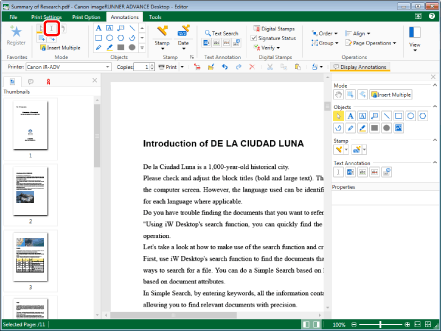
|
NOTE
|
|
If the Details Window is not displayed, see the following.
This operation can also be performed with the tool buttons on the toolbar. If tool buttons are not displayed in the toolbar of Desktop Editor, see the following to display them.
You can also insert underlines multiple times. For more information, see the following.
|
2.
Drag the mouse pointer on the Work Window to select the string to insert the underline in.
When the cursor passes over a selectable text string, the shape of the mouse pointer changes to  .
.
.If you clicked (Select Text) in step 1, proceed to step 3.
(Select Text) in step 1, proceed to step 3.If you clicked (Underline) in step 1, an underline is inserted in the text string, and underline properties are displayed on the Details Window. In this case, proceed to step 4.
(Underline) in step 1, an underline is inserted in the text string, and underline properties are displayed on the Details Window. In this case, proceed to step 4.|
NOTE
|
|
To cancel the insertion process, do one of the following.
Click
 (Select Object) on the ribbon (Select Object) on the ribbonClick
(Select Text) on the ribbonClick
 (Grab Mode) on the ribbon (Grab Mode) on the ribbonClick the command selected on the ribbon again
Click
 (Select Object) on the Details Window (Select Object) on the Details WindowClick
(Select Text) on the Details WindowClick
 (Grab Mode) on the Details Window (Grab Mode) on the Details WindowClick the selected button on the Details Window again
|
3.
Click (Underline) on the ribbon.
(Underline) on the ribbon.Or, follow one of the steps described below.
Click (Underline) on the Details Window
(Underline) on the Details WindowRight-click and select [Underline].
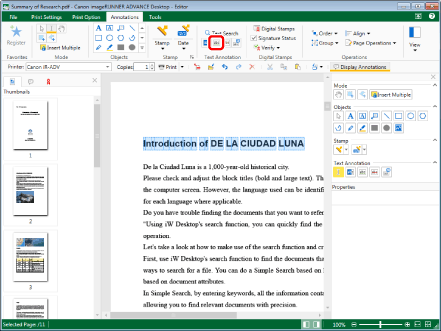
An underline is inserted into the text, and the underline properties are displayed on the Details Window.
|
NOTE
|
|
If the Details Window is not displayed, see the following.
This operation can also be performed with the tool buttons on the toolbar. If tool buttons are not displayed in the toolbar of Desktop Editor, see the following to display them.
|
4.
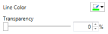
Configure the properties of the underline.
|
[Line Color]
|
Select the line color you want to use from the list displayed when you click
 . When you want to use a color that is not available in the list, select [More Colors]. . When you want to use a color that is not available in the list, select [More Colors]. |
|
[Transparency]
|
The slider position and the numeric value indicate the degree of transparency of the underline. To change the degree of transparency, move the slider to the left or right, or enter a numeric value. You can also use
 to change the degree of transparency. to change the degree of transparency. |
|
NOTE
|
|
If you select [More Colors] in [Line Color], the [Color] dialog box is displayed and you can set a color that is not listed in [Line Color].
Properties can also be set from ribbon commands or toolbar tool buttons. For information on the commands and tool buttons that can set properties, see the following.
|
5.
Click on the Work Window outside the underline you inserted to deselect the underline.