
<Common>
This section describes settings for functions such as Paper Feed Settings, Paper Output Settings, Print Settings, Scan Settings, and Generate File.
|
Some of the settings may not be displayed depending on the configuration of optional equipment installed on the machine. |
<Paper Source Auto Selection>
 (Settings/Registration)
  <Function Settings> <Common> <Paper Feed Settings>
You can configure the paper source that will be used when copying/printing with <Select Paper> set to <Auto>. This setting also functions when the paper in the current paper source runs out during copying/printing. Automatically Selecting the Appropriate Paper Source for a Specific Function
<Paper Source Auto Selection Based on Color>
(Settings/Registration) <Function Settings> <Common> <Paper Feed Settings>The paper source to use is automatically set according to the setting in <Select Color> when copying. If the original was scanned with <Auto (Color/B&W)> set, the color mode selected for scanning is used.
|
A setting other than <Black & White> is set for <Color>. This setting is only valid for copying. This setting is only valid when <Consider Color> in <Paper Source Auto Selection> is set to <On>. In the following cases, the paper source set in <Color> is automatically selected, regardless of the color mode specified when copying. When the Merge Job Blocks mode is set When the Different Size Originals mode and Job Build mode are set together |
<Suspended Job Timeout>
(Settings/Registration) <Function Settings> <Common> <Paper Feed Settings>If this setting is set to <On> and a job is suspended due to a lack of paper, etc., the machine automatically prints the next job after the specified time period.
|
If a job is suspended because paper has run out during the job, the next job is not processed even after the designated suspension time elapses. To automatically delete suspended jobs, see <Auto Delete Suspended Jobs>. |
<Output Tray Settings>
(Settings/Registration) <Function Settings> <Common> <Paper Output Settings>You can set the tray to output to for each function. Specifying the Output Tray for Preprinted Paper
<High Volume Stack Mode>
(Settings/Registration) <Function Settings> <Common> <Paper Output Settings>If your machine has multiple output trays, and is equipped with a finisher, you can fix the tray designation settings.
 |
In the following cases, output paper may not be aligned, or may fall down from the tray: When the <High Volume Stack Mode> is set to <On> (due to the temperature, humidity, characteristics of the paper type, or paper curling) When the <High Volume Stack Mode> is set to <On>, and output paper stack exceeds the maximum stack volume of the tray (Depending on the paper type or the functional mode that you are using, the output paper may exceed the stacking limit.) |
|
If this function is set to <On>, the tray order to which prints are output is fixed as follows: Tray B → Tray A → Tray C (if available). If the "Booklet Trimmer-F" is attached, the <High Volume Stack Mode> is not available. The <High Volume Stack Mode> cannot be set while you are copying or printing. If the Limited Functions Mode for a finisher is set to <On>, the <High Volume Stack Mode> is not available. If a Finishing mode is set, the output trays move downward as the stack of paper that is output increases in quantity and thickness. Once an output tray has reached its stacking limit, subsequent prints are automatically delivered to the next available tray. If all of the available trays have reached their stacking limits, printing stops temporarily. Remove all of the output paper from the trays. The trays move upward, and printing resumes. |
<Offset Jobs>
(Settings/Registration) <Function Settings> <Common> <Paper Output Settings>This enables you to shift the output for each job when multiple jobs are printed consecutively.
<Job Separator Between Jobs>
(Settings/Registration) <Function Settings> <Common> <Paper Output Settings>This enables you to insert the specified paper at the start of each job when multiple jobs are printed consecutively.
<Job Separator Between Copies>
(Settings/Registration) <Function Settings> <Common> <Paper Output Settings>This enables you to insert the specified paper each number of copy sets to divide the sets. If you set this, paper is inserted when printing with Collate (Page Order), Offset, or Staple.
|
You cannot insert job separation sheets between copy sets in the following cases: If you are using the Group, Booklet, Saddle Stitch, or Fold mode, or if you are using tab paper |
<Different Paper Sizes for Output Tray>
(Settings/Registration) <Function Settings> <Common> <Paper Output Settings>You can output different sized papers to the same output tray of the finisher.
|
If you set <Different Paper Sizes for Output Tray> to <Off>, printing may stop when the message <Remove the paper from the output tray.> appears. To resume printing, remove all of the paper from the output tray. If you set both the Different Size Originals and Staple modes, outputs are stapled and collated, regardless of the Different Paper Sizes settings. This mode can be set when the Staple Finisher-W PRO or Booklet Finisher-W PRO is attached. |
<Align Output Paper of Diff. Sizes (Diff. Widths)>
(Settings/Registration) <Function Settings> <Common> <Paper Output Settings>You can select whether to align the output paper by paper width when paper with different width is used for printing. If you set <Align Output Paper of Diff. Sizes (Diff. Widths)> to <On>, the machine automatically suspend the print job when paper with different width is output so that you can remove the output paper.
|
If you use paper smaller than A5R, the output paper cannot be aligned. |
|
When <Align Output Paper of Diff. Sizes (Diff. Widths)> is set to <On>, printing stops temporarily if all of the available output trays have reached their stacking limits. If you remove the output paper from the trays, the trays move upward and printing resumes. Even when <Align Output Paper of Diff. Sizes (Diff. Widths)> is set to <On>, you can align output paper if you are using paper with the same width. |
<Unprocessed Tab Paper Forced Output>
(Settings/Registration) <Function Settings> <Common> <Paper Output Settings>You can set whether to force to output excess tab paper that was not used.
|
If <Unprocessed Tab Paper Forced Output> is set to <On>, the extra amount of tab paper sheets that were not required for the job are forced out of the machine. Example: If the number of tabs is set to <5> and the machine estimates that seven sheets of tab paper are needed for the print job, you must prepare two sets of tab paper each containing five tabs (10 total). Therefore, if the machine only uses seven tab paper sheets, three tab paper sheets will remain. |
<Action When Too Many Sheets to Staple>
(Settings/Registration) <Function Settings> <Common> <Paper Output Settings>You can specify the procedure to perform when there are too many sheets to staple.
|
For information on printing using stapling, see Finishing with the Stapler. |
<Enable Offset for Single-Sheet Print Jobs>
(Settings/Registration) <Function Settings> <Common> <Paper Output Settings>Specifying <On> in this setting allows you to output single-page print jobs with the sheet offset in the following situations:
Shift is specified when job is received
Printing of multiple copies is specified when job is received
|
This setting is disabled for copy jobs. |
<Print Priority>
(Settings/Registration) <Function Settings> <Common> <Print Settings>A job that has a higher set priority can be set to print after the job currently being processed is complete.
|
If the same printing priority has been specified for multiple functions, printing starts with the first processed print job. Priority printing does not take place until the current job is complete. However, if the current job is paused, the printing of another job may start, depending on its settings. |
<Productivity/Image Qlty. Priority for Mixed Paper Type>
(Settings/Registration) <Function Settings> <Common> <Print Settings>To prevent the quality of the image from being adversely affected in specific conditions, you can give a priority to quality over productivity.
|
When printing on paper with different widths and if uneven glossiness/density appears on the output, select <Quality Priority>. |
<Text/Photo Priority When Recognized as B&W by ACS>
(Settings/Registration) <Function Settings> <Common> <Print Settings>You can set the quality to use when an original is detected to be black-and-white with auto color selection.
|
If you set <Text Priority> in this setting and your original is determined as black-and-white by the <Auto (Color/B&W)> mode in <Select Color>, the original is processed as if you selected <Text> as the original type setting, even if you select a mode other than <Text> for <Original Type> in <Copy>. |
<Conversion Color by Specific Color for Two Colors Print>
(Settings/Registration) <Function Settings> <Common> <Print Settings>You can select the specified color to use when printing using the two-color mode, which prints in black and a specified color. The two-color mode can be set for copying or printing. This setting is reflected in both the two-color mode for printing and the two-color mode for copying.
All Chromatic Colors: When specifying the color to use for all chromatic colors other than black in the original (or image data).
Approximate Colors Only: When using the color for only the specified color (or approximate color) and using black for all other chromatic colors in the original (or image data).
 Example Replaced Colors and Settings
When the two-color mode is specified for an original (or image data) including the following colors, the colors are replaced as indicated below.
Colors included in the original (or image data): Red, orange, blue, black
Red specified for the two-color mode
Original (or image data) 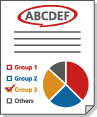 | "All Chromatic Colors" 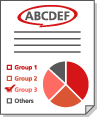 | "Approximate Colors Only" 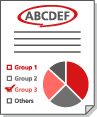 |
Red | Red | Red |
Orange | Red | Red |
Blue | Red | Black |
Black | Black | Black |
<2-Sided Printing>
(Settings/Registration) <Function Settings> <Common> <Print Settings> <Output Report Default Settings>You can specify the 2-Sided Printing for printing reports such as Send TX Report and Communication Management Report.
<Register Form>
(Settings/Registration) <Function Settings> <Common> <Print Settings>You can register image forms and superimpose them on output using the Superimpose Image function.
|
Make sure you place the original that contains the image form on the platen glass. It is not possible to scan an image form from the feeder. |
|
For information on the Superimpose Image function, see Superimposing Images. You can register up to 100 image forms. However, this number varies depending on the capacity of the hard disk. Image forms can also be registered in the machine from a computer. For details, see the help for the printer driver. |
<Image Quality Priority for Superimpose Image>
(Settings/Registration) <Function Settings> <Common> <Print Settings>This mode enables you to set the machine to automatically select whether the print quality of your original has priority or the print quality of the stored image form has priority.
 |
The following image processing is performed according to the settings, as indicated below. <Auto>: The form image after superimposition is processed so that the image quality is the same as when only the form is printed or copied. The original image after superimposition is processed so that the image quality is the same as when only the original is printed or copied. However, if the print areas of the form image and original image overlap, the image is processed with the image quality of the form image prioritized. <Original Priority>: The original image after superimposition is processed so that the image quality is the same as when only the original is printed or copied. <Form Priority>: The form image after superimposition is processed so that the image quality is the same as when only the form is printed or copied. |
<Register Characters for Page Numbering/Watermark>
(Settings/Registration) <Function Settings> <Common> <Print Settings>You can register/edit/delete user-defined text for <Page Numbering>/<Watermark>. It is useful if you always use the same text or watermark for <Watermark> in <Secure Watermark>, and <Page Numbering> and <Watermark> in the Copy/User Inbox function.
|
For information on <Watermark> in <Secure Watermark>, and <Page Numbering> and <Watermark>, see Attaching Numbers and Symbols to Copies and Embedding the "TOP SECRET" Text (Secure Watermark). You can register up to 30 user-defined text strings for watermarks and page numbers. |
<Copy Set Numbering Option Settings>
(Settings/Registration) <Function Settings> <Common> <Print Settings>In addition to Copy Set Numbering, you can add User Name, Date, and Text on the printout.
<Forced Print of Recognition Information>
(Settings/Registration) <Function Settings> <Common> <Print Settings>You can force to print the user ID, date, IP address, or serial number of the machine on the printout. Printing User Information on Documents
|
IPv6 addresses cannot be printed. |
<Forced Secure Watermark>
(Settings/Registration) <Function Settings> <Common> <Print Settings> <Secure Watermark Settings>Secure Watermark enables you to prevent information leakage. These functions can be set by administrator so that it is always reflected on the output by the general users. Embedding Invisible Text (Forced Secure Watermark)
<Printer Driver Secure Watermark>
(Settings/Registration) <Function Settings> <Common> <Print Settings> <Secure Watermark Settings>When printing from a printer driver, you can select the functions set here for each job.
|
If <Printer Driver Secure Watermark> and <Forced Secure Watermark> are set for a printer at the same time, Forced Secure Watermark is given priority. |
|
If a login service has been set, the user name/Department ID of the user who logged in is printed. The watermark <CONFIDENTIAL> is printed if a login service is not set. To use this function, specify the following settings in the printer driver in advance. For details, see the help for the printer driver. |
<Adjust Background/Character Contrast>
(Settings/Registration) <Function Settings> <Common> <Print Settings> <Secure Watermark Settings>Adjusts the relative contrast of the hidden text and the background. The Secure Watermark effect can be tested by making a copy of a sample print. The following settings are specified here.
<Relative Contrast>: Adjusts the relative contrast of the hidden text and the background.
<Standard Value Settings>: Sets the density of the background.
<Latent Area Density>: Sets the density of the text.
|
Load A3, A4, LTR, or 11" x 17" size plain or heavy paper when making sample prints. |
<Quickly Exit Sleep Mode for Print Job>
(Settings/Registration) <Function Settings> <Common> <Print Settings>If you perform LPD/RAW printing while the machine is in sleep mode, it may take some time to start printing. If this setting is set to <On>, this time can be reduced.
<Auto Delete Suspended Jobs>
(Settings/Registration) <Function Settings> <Common> <Print Settings>If this setting is set to <On> and a job is suspended due to a paper jam, etc., the machine automatically deletes the job after the specified time period.
|
To retain a suspended job without automatically deleting it, see <Suspended Job Timeout>. |
<Timing to Raise Feeder Tray>
(Settings/Registration) <Function Settings> <Common> <Scan Settings>You can select the timing for raising the feeder tray when scanning originals using functions such as Scan and Store, and Copy.
<Feeder Jam Recovery Method>
(Settings/Registration) <Function Settings> <Common> <Scan Settings>You can select whether scanning will start again from the first page of the original or the page of the original in which scanning was interrupted if a paper jam occurs in the feeder.
|
Direct sending of faxes does not support this setting. If a paper jam occurs while performing direct sending, the job will be canceled. In this case, set the job again. Depending on the location of a paper jam, it can be difficult to determine whether document scanning has been completed. If you have set <From Suspnd. Original> for <Feeder Jam Recovery Method> and you do not find until which page the document has been scanned, it is recommended that you cancel the job, and then execute it again. |
|
Select one of the following. <From 1st Page>: Place the originals in the feeder again, and then restart scanning from the first page of the document. The originals will be fed automatically until the page of the document in which scanning is interrupted. <From Suspended Original>: Place the originals that were not scanned because of a paper jam in the feeder, and then start scanning all the remaining originals again. |
<Set Detection of Feeder Multi. Sheet Feed as Default>
(Settings/Registration) <Function Settings> <Common> <Scan Settings>You can specify the default setting of <Detect Feeder Multi Sheet Fd.> for each function. Basic Copy Operations Basic Operations for Scanning Originals Sending I-Faxes Basic Operations for Sending Faxes
<Scanner Noise Settings>
(Settings/Registration) <Function Settings> <Common> <Scan Settings>You can set whether priority is given to scanning speed or to noise reduction when the original is scanned from the feeder.
<Streak Prevention>
(Settings/Registration) <Function Settings> <Common> <Scan Settings>You can set whether to detect and prevent streaks when scanning originals.
|
When <On> is selected, extremely thin lines may be detected as streaks. |
<Speed/Image Quality Priority for B&W Scan>
(Settings/Registration) <Function Settings> <Common> <Scan Settings>You can set whether priority is given to scanning speed or to image quality when performing black and white scanning.
<LTRR/STMT Original Selection>
(Settings/Registration) <Function Settings> <Common> <Scan Settings>You can forcibly designate the way the machine handles LTRR and STMT originals that are placed on the platen glass.
<Remote Scan Gamma Value>
(Settings/Registration) <Function Settings> <Common> <Scan Settings>You can set the gamma value to use when scanning color documents into your computer through the Network Scan function. Select the gamma value most suited to your computer settings so that you can print the document with the optimal density.
<Auto Online>
(Settings/Registration) <Function Settings> <Common> <Scan Settings>Set this to <On> to automatically enable the remote scanner function when you press <Scanner> (<Home> Screen).
|
When the remote scanner function is enabled, you cannot use <Copy> and <Scan and Store>. |
|
You can specify the time period in which you are logged out and the touch panel display returns to the default setting automatically. |
<Auto Offline>
(Settings/Registration) <Function Settings> <Common> <Scan Settings>If the machine is connected to a network that is online, scanning is not possible with <Copy> or <Scan and Store>. If you set <Auto Offline> to <On>, the machine automatically goes offline when the time set in <Auto Reset Time> in <Preferences> (Settings/Registration) has elapsed.
|
If <Auto Reset Time> is set to <0>, the machine automatically goes offline after approximately two minutes. You can specify the time period in which you are logged out and the touch panel display returns to the default setting automatically. |
<Image Quality Level for Limited Color/Compact>
(Settings/Registration) <Function Settings> <Common> <Generate File>If you select PDF (Compact/Low Color)/XPS (Compact) as the file format when using <Scan and Send> or <Scan and Store>, you can set the image quality level of the document.
|
This setting is disabled when sending a fax or I-fax. If you set both <OCR (European Languages)> and <Compact> for the file format, this setting is disabled. |
|
If you scan an original with many colors when <Text> is selected for the original type, the data size and image quality will vary following compression, according to the selected image level. However, if the original is in monochrome or has few colors, it does not matter which image level you select. |
<PDF (Limited Color) Resolution Settings>
(Settings/Registration) <Function Settings> <Common> <Generate File>If you select PDF (Low Color) as the file format when using <Scan and Send> or <Scan and Store>, you can create a smaller PDF file by lowering the resolution.
|
This function is applied when <Original Type> is set to <Text>, even if <Image Quality Level for Limited Color/Compact> is set to <Quality Priority>. <Image Quality Level for Limited Color/Compact> |
<OCR (Text Searchable) Settings>
(Settings/Registration) <Function Settings> <Common> <Generate File>If you select <OCR (Text Searchable)> for <PDF> or <OOXML> as the file format, you can set the Smart Scan setting, and set the number of characters used for the Auto (OCR) in File Name. Smart Scan is a mode that determines the text direction and rotates the data, so that the document will be in the correct orientation when viewing the document on a computer. Auto (OCR) in File Name is a mode that automatically uses the first text scanned by OCR in the document as its file name. Auto (OCR) in File Name is specified in <File Name> in <Options> on the Scan and Send screen. Setting a File Name
|
You cannot use the Auto (OCR) in File Name mode and the Encrypted PDF mode at the same time when sending a file. |
<Trace & Smooth Settings>
(Settings/Registration) <Function Settings> <Common> <Generate File>You can change the recognition rate of line drawings of the original when creating a file with outline graphics.
|
If you increase the value in <Graphics Recognition Level>, the data size also increases. It is recommended that you first use <Normal>, and if desirable results are not obtained, try increasing the recognition level to <Moderate> or <High>. This setting is disabled when sending a fax or I-fax. |
<OOXML Settings>
(Settings/Registration) <Function Settings> <Common> <Generate File>You can specify the background image level, color image recognition level, and color image line width recognition when creating files with Office Open XML file format.
|
This setting is disabled when sending a fax or I-fax. Color image settings are only valid with PowerPoint. |
<Include Background Images in Word File>
(Settings/Registration) <Function Settings> <Common> <Generate File>When generating Word files from scanned originals, you can delete the image detected as the background in the Word files. It becomes easier to edit Word files because unnecessary images are deleted.
<Specify Minimum PDF Version>
(Settings/Registration) <Function Settings> <Common> <Generate File>You can specify the minimum version to assign when generating PDF files.
|
Depending on the functions set for the PDF files, the version assigned may be higher than that specified with this setting. |
<Format PDF to PDF/A>
(Settings/Registration) <Function Settings> <Common> <Generate File>You can create PDF files compliant with PDF/A-1b. This is suited for long-term storage because it guarantees that the visual quality of the PDF does not change with the machine or viewing software.
This setting is linked with the following default settings:
<File Format> in <Scan and Send>
<File Format> in <Scan and Store>
<File Format> in <Send> in <Access Stored Files>
<File Format> in <Forwarding Settings>
|
This setting is disabled when sending a fax or I-fax. The following PDF functions cannot be set if <Format PDF to PDF/A> is set to <On>. Encryption Visible Signature |
<Optimize PDF for Web>
(Settings/Registration) <Function Settings> <Common> <Generate File>You can create a PDF that displays only the pages that are already downloaded even when a file is still being downloaded.
|
This setting is disabled when sending a fax or I-fax. If you set <Optimize PDF for Web> to <On>, this setting can be used with one of the following settings: Device Signatures User Signatures |
<256-bit AES Settings for Encrypted PDF>
(Settings/Registration) <Function Settings> <Common> <Generate File>When generating an encrypted PDF file, you can select <Acrobat 3.0 or Later/40-bit RC4>, <Acrobat 6.0 or Later/128-bit RC4>, <Acrobat 7.0 or Later/128-bit AES>, or <Acrobat 10.0 or Equivalent/256-bit AES> as the PDF encryption level. If you want to use <Acrobat 9.0 or Equivalent/256-bit AES> rather than <Acrobat 10.0 or Equivalent/256-bit AES> as the encryption level, use this setting to change the selections you can make.
|
This setting is disabled when sending a fax or I-fax. |
<Rights Management Server Settings>
(Settings/Registration) <Function Settings> <Common> <Generate File>This machine can link with Adobe LiveCycle Rights Management to generate PDF files that have viewing and other privileges managed.
|
Adobe LiveCycle Rights Management ES series software is required to use this setting. For more information, contact your dealer or service representative. To use this setting, the Adobe LiveCycle Rights Management server and this machine must be connected via the Internet or an intranet. For information on the IP address, host name, and port number, contact the administrator of the Adobe LiveCycle Rights Management server. |
<Information Used for LDAP Server Authentication>
(Settings/Registration) <Function Settings> <Common> <Set Authentication Method>You can specify the authentication method for accessing an LDAP server.
|
When <Device Settings> is set The information set in Registering the LDAP Server is used. When <Device Login Authentication Information> is set The authentication information used when logging into the machine is used. When <Registered Information for Each User> is set The authentication information of the LDAP server is registered for each user. <Device Login Authentication Information> is available only when using the same authentication information for logging in to the machine and accessing the LDAP server, and when using a login service which supports Integrated Authentication. For information whether the login service you are using supports Integrated Authentication, contact your dealer or service representative. When <Registered Information for Each User> is selected, each user sets the user name and password used for LDAP authentication on the Send Basic Features screen  <Register/Edit Information for Each User> <LDAP Server Authentication Information>. <Register/Edit Information for Each User> <LDAP Server Authentication Information>. |
<Information Used for Rights Management Server Auth.>
(Settings/Registration) <Function Settings> <Common> <Set Authentication Method>You can specify the authentication method for accessing a Rights Management server.
|
When <Device Settings> is set The information set in <Rights Management Server Settings> is used. When <Registered Information for Each User> is set The authentication information of the Rights Management server is registered for each user. When <Registered Information for Each User> is selected, each user sets the user name and password used for Rights Management server authentication on the Send Basic Features screen <Register/Edit Information for Each User> <Rights Management Server Authentication Information>. |
<Information Used for SMTP Server Authentication>
(Settings/Registration) <Function Settings> <Common> <Set Authentication Method>You can specify the authentication method for accessing an SMTP server.
|
If you select <Device Settings> Uses the information that was set in <Authent./Encryption> (Setting E-mail/I-Fax Communication). If you select <Register Info. for Each User> Registers and uses SMTP server authentication information for each user. If <Register Info. for Each User> is selected, each user has to press <Scan and Send> <Register/Edit Information for Each User> set the user name and password used for SMTP authentication in <SMTP Server Authentication Information>. |
<Information Used for File TX/Browsing Authentication>
(Settings/Registration) <Function Settings> <Common> <Set Authentication Method>You can specify the authentication method for accessing a file server.
|
<Device Login Authentication Information> is only valid for SMB and WebDAV. When <Normal> is set The information set in Registering Destinations in the Address Book is used. When <Device Login Authentication Information> is set The authentication information used when logging into the machine is used. When <Registered Information for Each User> is set The authentication information of the file server is registered for each user. When <Registered Information for Each User> is selected, each user sets the user name and password used for file server authentication on the Send Basic Features screen <Register/Edit Information for Each User> <Authentication Information for File TX/Browsing>. |